
Issues raised by the industry, like rationalisation of the eight per cent central excise on jet fuel, still remain to be addressed. As a result of the government abolishing five per cent customs duty on aviation turbine fuel from Tuesday, state-run oil firms have cut jet fuel prices by Rs 2,100 per kilo litre, on top of the 17 per cent price reduction announced late last week.

As part of cost reduction efforts, the full service carrier has asked its employees, including pilots, to take steep pay cuts

Liquor baron Vijay Mallya on Wednesday met Oil Secretary S Sundareshan to discuss defaults by his group firm Kingfisher Airlines on payment of jet fuel bills, but did not say when he will clear the outstanding of Rs 176 crore (Rs 1.76 bilion).
Cracks started appearing on Saturday in a grouping of airlines that was planning to suspend flights on August 18 to protest high jet fuel prices and taxes, with budget carrier IndiGo saying it would operate as usual.

In an unprecedented show of solidarity on Friday in Mumbai, India's cash-strapped, loss-making private airlines -- including Kingfisher Airlines, Jet Airways, and others -- have demanded a bailout package from the government or they 'will have to suspend their operations indefinitely'.
The government is unlikely to ban export of petroleum products or review the export-oriented status of Reliance Industries Jamnagar refinery, as has been demanded by United Progressive Alliance government's new ally, the Samajwadi Party.
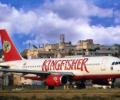
Vijay Mallya-promoted Kingfisher Airlines has turned second time lucky; the state-run Bharat Petroleum Corporation (BPCL) has granted it a three-month reprieve to pay jet fuel dues. KFA owes BPCL Rs 220 crore (after adjustment of interest) for fuel dues.

One reason is that airlines have ramped up capacity and expanded their presence in tier-II markets. The first of a three-part series analyses how the aviation industry is an outlier in the midst of an overall economic slowdown.
The Centre asked state governments on Friday to review and rationalise their taxation policy on jet fuel and land acquisition practices to encourage the expansion of civil aviation sector so that they could themselves reap the benefits of its unprecedented growth.

The provisional restructuring plan has been carried out by lenders, led by State Bank of India, under the Reserve Bank of India's February 12, 2018 circular.

Private and public sector oil firms have opposed levy of five per cent customs duty on crude saying this would make import of products like jet fuel cheaper than manufacturing them in the country.
The budgetary provision for all aviation infrastructure has generally been reduced, apparently with the view that most of the airport modernisation programmes, barring those in Kolkata and Chennai, were being carried out through public-private partnership.
Budget air-carrier, SpiceJet, expects to break-even this fiscal, a top company official said. The break-even could come on the back of stabilising fuel prices and an increasing demand for low-fare travel, he said. The air-carrier expects oil prices to stablise in the range of $65-70.
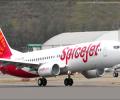
This is also the highest ever profit recorded by the carrier, which was facing turbulent times a year ago.
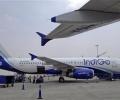
IndiGo's ascent is not without its risks, however.
The events, trends, and goofs that defined 2008

Though a formal purchase agreement with Boeing is yet to be signed, SpiceJet's order size could be of 40-50 planes, a source familiar with the development said. At list price, a 737 Max aircraft is valued at about $100 million (Rs 620 crore).
All major airlines in the country are likely to hike the fuel surcharge by Rs 100 with effect from September 5, raising the total surcharge to Rs 750.
This is three and a half times the loss in the same quarter a year ago.

The Union Cabinet is likely to take up the airline industry's concerns over high taxes on jet fuel and airport charges at its next meeting and a Group of Ministers (GoM) may be set up to focus on ATF pricing.
The end of the monopoly of oil PSUs on selling jet fuel at Delhi and Mumbai airports is expected to bring competition and more transparent pricing.
Singapore Airlines General Manager in India C W Foo said India was one of the top five markets across the world for the carrier and it would not allow short term fluctuations to affect its long term strategies in India. Foo said the carrier was looking at increasing its frequencies from Bangalore, New Delhi and Chennai as these routes have dense traffic.
Indian carriers, which are still reeling under high jet fuel prices, are now seeing red over airports increasing the space rental fees by 50 to 450 per cent. Airport charges account for 12-15 per cent of an airline's costs.

Amid record-high fuel prices, Finance Minister Nirmala Sitharaman on Monday said there is no proposal as of now to bring crude oil, petrol, diesel, jet fuel (ATF) and natural gas under the Goods and Services Tax (GST). When the GST was introduced on July 1, 2017, amalgamating over a dozen central and state levies, five commodities - crude oil, natural gas, petrol, diesel, and aviation turbine fuel (ATF) - were kept out of its purview given the revenue dependence of the central and state governments on this sector. This meant that the central government continued to levy excise duty on them while state governments charged VAT. These taxes, with excise duty, in particular, have been raised periodically.
The hike comes on back of over 12 per cent hike on June 15. ATF price on that day were raised by Rs 3,949 to Rs 36,252 per kilolitre in Delhi.
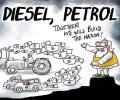
The government on Friday slapped an export tax on petrol, diesel and jet fuel (ATF) while also joining nations like the UK in imposing a windfall tax on crude oil produced locally. A Rs 6 per litre tax on export of petrol and ATF and Rs 13 per litre tax on export of diesel is effective from July 1, finance ministry notifications showed. Additionally, a Rs 23,250 per tonne tax was levied on crude oil produced domestically.
An airlines industry body has sought reduction in customs and excise duties on aviation turbine fuel and allowing private firms to supply it to bring down prices.

the airline is giving 30 per cent discount on tickets.
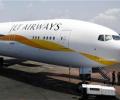
Currently, Etihad has 24 per cent shareholding in Jet Airways
Failure to reinstate salary even two years after the drastic cuts has landed the airline industry in a massive industrial relation crisis. While employees of Air India had organised a strike back in 2011, it is for the first time that private airlines are facing serious stress related to workers. IndiGo witnessed two of them, back to back. In the first instance, around 50 per cent of the IndiGo flights were delayed as a large number of crew members went on mass sick leave, apparently to participate in a rival airline's walk-in job interview.
As a measure to increase productivity and reduce costs amid rising jet fuel prices, low cost airline GoAir has reduced the number of flights to various sectors.
The worldwide softness in the sector has ensured there are few takers for these aircraft; those who had leased the aircraft to Indian carriers will invoke a hefty penalty if the machines are sent back to them.

Ajay Singh will team up with two blue-chip investors to bail out the airline
Private airlines will explain before the Delhi High Court the reasons for imposing a Rs 150 per head surcharge to meet additional jet fuel expenses while aircraft hovers over major airports due to air traffic congestion.

A senior first officer with Jet Airways shares her plight.

The market, however, reacted negatively to SpiceJet's announcement and the company's stock dropped by 0.87 per cent as analysts became wary of diversion into a new business during a high fuel price environment.
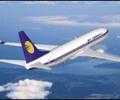
It will provide Jet Airways and the Arab airline members of AACO, with opportunities to create synergies.

High taxes on the jet fuel, which goes up as high as 40 per cent in some states, coupled with higher airport charges in the form of user development and airport development fee, which have cascading effect on the air fares, have had a negative impact on the domestic passenger demand in India.
